


smart factory
OUR SERVICES
Development of ‘Smart Factory’,
A smart factory is a human-centered high-tech intelligent factory that integrates all production processes from product planning to sales with ICT (Information Communication) technology to produce customized products at minimum cost and time. Jtomorrowone Co.,Ltd. presents a direction for corporate customers to realize a perfect smart factory in connection with government support projects.
Every manufacturing process gets smarter

Simulation before product production in virtual space
Real-time information exchange between facilities, materials, and systems
Real-time automatic order placement tailored to production status
Shorten duration,
Custom product development
Custom product development
Many kinds of mass production,
Inventory of energy facility efficiency
Inventory of energy facility efficiency
Reduced inventory cost,
Cooperation in all areas including quality and logistics
Cooperation in all areas including quality and logistics
Smart factory connection for manufacturing innovation
A smart factory must be able to accurately grasp the flow of data occurring at the manufacturing site based on ERP.
By connecting various solutions required for a smart factory, the smart factory that companies want is realized and the first step toward manufacturing innovation begins. JTomorrowOne connects the future for a perfect smart factory.

Possible to build step by step according to the size of the company
The support stage of a smart factory enables companies to select appropriate levels and functions according to their circumstances, enabling gradual implementation accordingly.
Small and medium-sized enterprises (SMEs) are building the groundwork to get started easily and at relatively low cost, and we are delighted with the results that have exceeded our expectations.
Even at the basic stage of a smart factory, products produced in real time can be counted and managed immediately, and material history management (lot-tracking) is also possible.
| Separate | On-site automation | Factory operation | Enterprise resource management | Product development | Supply Chain Management |
|---|---|---|---|---|---|
| Altitude | CPS based on IoT/IoS | on the Internet space business CPS Network Collaboration |
|||
| IoT/IoS ization | Diagnosis and operation based on IoT/IoS (modular) big data | ||||
| middle 2 | Facility control automation | Real-time factory control | Factory operation integration | simulation and batch Process automation |
Multi-product development collaboration |
| middle 1 | Automatically aggregate equipment data | Real-Time Decision Making | Integration between features | create technical information Automation and Collaboration |
Multi-product production collaboration |
| basic | Automated Performance Aggregation | Process Logistics Management (POP) | focused on management functions Individual function operation |
via server Technology/delivery management |
Reliance on a single parent company |
| ICT not applied | Manual | Manual | Manual | Manual | Phone and email collaboration |
From smart factory to intelligent factory
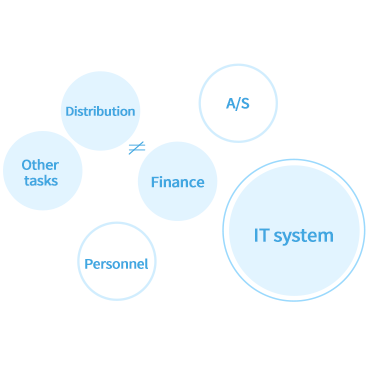
(1) Need to introduce a standard system
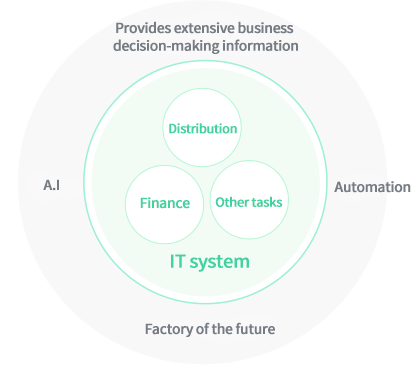
Due to the introduction of ERP for smart factories, the corporate management information system environment will be very different from the existing one. Clever ERP systems are top notch
You must be able to contribute to decision making. It is essential to integrate scattered tasks and establish data according to rules and standards. Through this, the future
We could be getting closer to a super-intelligent factory.
AS-IS
TO-BE
(2) Smart Factory Work Changes
Integrated logistics and finance data can be expected to improve efficient work in the management aspect, which can lead to strengthening of production competitiveness and higher leveling of work.
there is. It also contributes to top-level decision-making. Through this, we can even lay the groundwork for innovation to expand new businesses.
AS-IS(limited present)
- Lower work efficiency and reliability due to separate system management for finance and logistics
- Need to establish company-wide business process and system structure in preparation for business site expansion
- Need to reduce defect rate through production process management and quality control activity planning
- Information sharing and provision of real-time decision-making information through the system, multi-dimensional profit and loss analysis needs to be improved
TO-BE(Key Benefits, scalable future)
- Establishment of master data system and establishment of new/revision process
- Establishment of receipt/payment processing system based on purchase/outsourcing warehousing and payment/receipt basis
- Steady cost reduction possible through cost analysis of actual cost by cost
- Checking real-time flow through ICT connection, enabling smart production management through establishment of monitoring system
- Management information of the information system that can support strategic decision-making and various reports for each task can be provided

